




A steady clicking noise pulsates every second inside the milking shed on a dairy farm in East Bernstadt.
Third-generation dairy farmer Ronnie Patton has attached milkers to three dairy cows lined up inside.
“What we're doing is with these, we're simulating what a calf does here on a cow with pulsation. It pulses like a sucking sound, and that's what that does, and the cow lets her milk down.”
Four milkers are attached to the cow’s teats, and milk swirls through sanitized pipes to a glass container before going into a refrigerated 800-gallon tank. In all, Ronnie will milk twenty cows twice a day, seven days a week. It’s hard work that can be challenging when dealing with 1200-to-1500-pound animals.
“You can get hurt in there. Yes, you can get kicked, and you'll get pooped on. It's where it hits you when they do it, it hits you in the face.”
Ronnie says his 200-acre farm is the last dairy farm left in Laurel County. Nationwide, the number of small dairy farms has plummeted 63 percent in the last ten years. Small farm extension agent Laura Rogers from Kentucky State University says fewer people in the younger generations are farming for a living.
“One thing is that our population is getting older. I don't see as many 18, 19, 20-somethings doing it. It's hard work. And they've been taught, stay on the computer. Look at the laptop. You can't look at a laptop. And, you know, hoe a garden, you got to do one or the other, and it tastes discipline.”
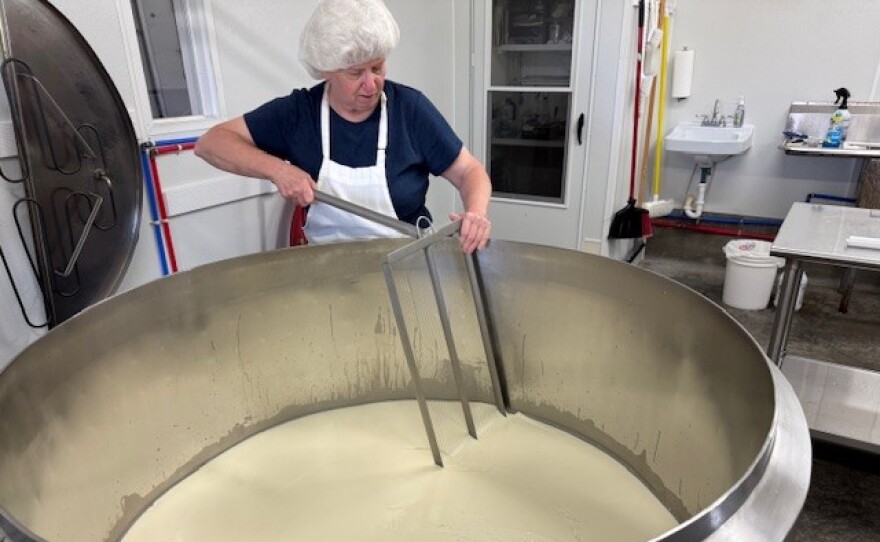
Ronnie and his wife Clara, who makes cheese from their cow’s milk, occasionally bring in help, but most of the time the couple does the work. For Clara, it’s 12-hour days when she makes cheese twice a week. She works in a 400-square-foot sanitized room in the rear of the couple’s cheese shop at Wildcat Mountain Cheese.
Clara has a degree in food science and worked as a health environmentalist.
“Cheese making is an art, plus science coming together. There's just certain things you know to do at certain times, the look, the feel of it. Science isn't necessarily going to tell you that science, a little bit more like temperatures controlled, pH, things like that, and then the bacteria, what they will do, but it's just everything coming together.”
Clara wears a white work apron, a hair net, and booties on her shoes to keep from tracking dirt and germs into the cheese-making room. Steel sinks, a steel table, and a two-hundred-gallon vat fill the room. The vat is half full of milk.
“It's low-temperature batch pasteurization, meaning we heat it to 145 Fahrenheit for 30 minutes, and the pasteurization will kill off stray bacteria and potential pathogens that could be in the milk, and that levels the playing ground for the cultures, which is bacteria that we add into the milk to control, for the control of the cheese making. It's the cultures that ultimately will give the cheese the flavors. We use one type of culture for like Gouda, a different culture for cheddar, a different strain of bacteria for Swiss. So, they're all different.”
A nearby cooling room is lined with shelves holding different kinds of homemade cheese.
“We do Colby Gouda cheddars, and we do some flavored cheddars, like we do white cheddar, and we also do a traditional yellow cheddar. We then do a garlic pepper chatter, a pioneer coffee rub, and a jalapeno cheddar. We also make Swiss, and we named our Swiss Bernstadt Swiss, after our community of East Bernstadt. And we also do fresh cheese curds, which are white cheddar curds. We do those in about three different flavors.”
The Pattons sell their cheese from the farm shop and at small retailers from London to Lexington, and over in Huntington, West Virginia. The couple also sells their cheese at farmers’ markets where they get face-to-face feedback.
Clara says, “the real joy comes later on, when you're either serving that cheese, like some of the events that we do and or at the farmers market, and people just come back and they're just, oh, you have very good cheese, the best cheese in the world, or just those comments from people and the joy that they seeing them enjoy the product.”
One of the joys Ronnie experiences is bottle feeding the newborn calves. “I think it's most innocent things on God's green earth, a little baby calf, yeah. They're precious. And they grow up to be mean cows.” He laughs about that.
Ronnie names all his dairy cows. All part of running a small dairy farm. It’s a life the Pattons appreciate and do well. Ronnie has a framed picture of his grandfather in the cheese shop to remind him of his roots.
“My grandfather started the dairy in the 30s. Early 30s, they sold cream. And then in ‘39 they went to selling fluid milk, and he farmed it. When my dad came back from the Korean War he helped. And then when I got out of school in the 70s, I stayed here and done this.” If you’d like more information on the Pattons’ cheese, check out Wildcat Mountain Cheese on Facebook.
**The 1850 campaign is replacing lost federal funds one supporter at a time. Thanks to our listeners and supporters, we are very close to reaching our goal of 1850 new supporters donating at least $10 a month. Click here to join the campaign!


