

This week, about two dozen reporters piled on a tour bus along with Louisville Emergency Management’s Executive Director Jody Meiman. Driving down Grade Lane, he pointed out where the UPS cargo plane slammed into the ground near a petroleum recycling center in early November, erupting into a fireball.
“So when you get out, you'll be able to see the area and the debris field that was there,” Meiman said, motioning toward the windows. “Obviously, this has been cleaned up dramatically, but you can still see the patterns on the ground.”
The bus eventually stopped and everyone gathered on a large dusty pad of concrete. There stood semi-trailers that looked as though they’d been torn open by a monster's claws. In reality it’s where the thinnest strips of metal melted from the heat of burning jet fuel.
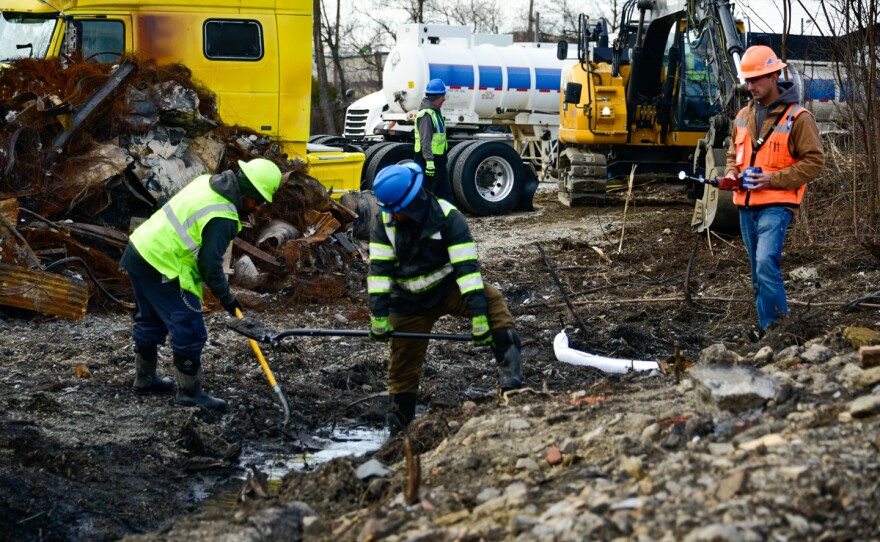
Nearby, orange X’s were spray painted on the doors of incinerated and rusted vehicles lined in rows – evidence they’d been searched for bodies. Elsewhere, workers in orange vests used shovels to carefully direct oily water along a ditch and into a well where it’s pumped into a truck.
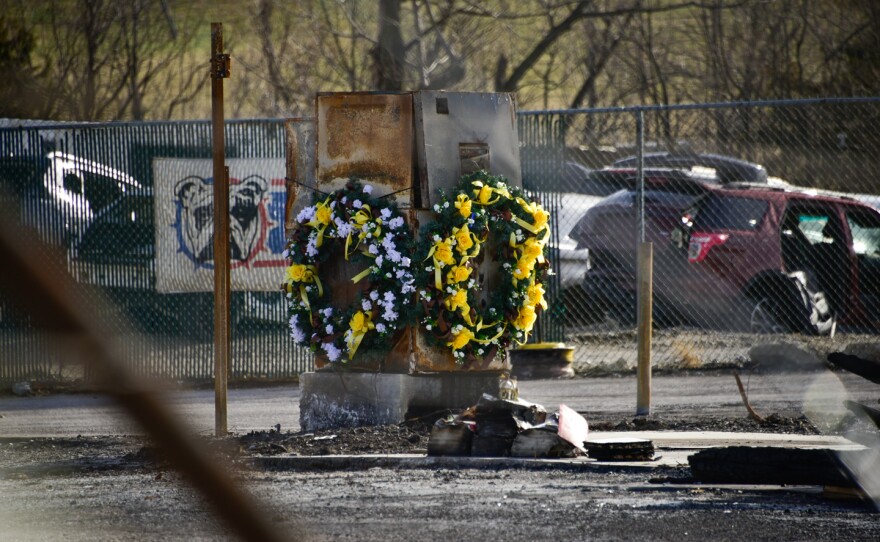
Amid the burned metal, orange vests and chain link fences, someone tied two large wreaths to a rusted pole, their yellow ribbons and pale blue flowers swayed in the breeze, commemorating the victims found there.
It’s all part of the site where the National Transportation Safety Board collected evidence after the crash. They’re gone now, but their investigation is ongoing.
So far, they’ve determined there were fatigue cracks in hardware meant to hold the left engine to the MD-11 cargo plane that crashed after the left engine separated and caught fire while taking off.
On Wednesday they released an update, saying that Boeing was aware of a defect in that model plane since 2011.
The NTSB evidenced a service letter from nearly 15 years ago, showing that Boeing knew about a defect on the bearings for MD-11s, and didn't consider it to be a safety concern that might require action, although the bearing had failed at least four previous times.
Service letters are generally informational, unlike service bulletins or airworthiness directives that require action.
The safety board is still reviewing planning documents, maintenance schedules and communication between Boeing and UPS related to the defect.
UPS and Boeing say they’re supporting the federal investigation, but won’t comment on it directly. Both say their thoughts are with the recovery effort.
“Our thoughts continue to be with the families and Louisville community who are grieving, and we remain focused on the recovery effort,” UPS said in a statement.
But here in Louisville, the focus at the crash site isn’t on what caused the crash — it’s on the aftermath.
Workers are out here directing ditches of oily water into small reservoirs to pump out. They’ve collected insane amounts of gallons of contaminated water and treated it so far. (Think of it like a French drain / sump pump system in your basement.)
— Justin Hicks (@justinhicks.lpm.org) January 13, 2026 at 2:20 PM
[image or embed]
Mayor Craig Greenberg says a lot of work has already been done since he first toured the site with politicians days after the crash, which he called a “full body experience.”
“[I remember] ]the look on the first responders faces… there was just oil residue that was everywhere…seeing firefighters walk with stretchers towards areas where flags were in the ground, where bodies had been sighted by recovery personnel,” Greenberg said, during the press tour on Tuesday.
Meiman with Louisville Metro says the city feels confident there won’t be any long term environmental impacts from the crash, which he credits to the fast action of clean up crews.
“There was four feet of oil in the road,” he said, recalling the scene after the plane crash. “Some of that was on fire where the plane hit the oil tanks. So, you know, that was a challenge.”
To clean up that oil, those clean-up crews had a bit of luck on their side. Nearby the crash site is a 60-acre pond called Melco Basin. Years ago, MSD dug this to control flood water. Now, it's plugged up, and naturally sequesters the oil slick instead.
Brian Bingham with Louisville’s Metropolitan Sewer District says the basin didn’t catch everything, but it helped clean up crews focus on active creeks first and prevent oil from continuing to spread into local waterways.
“So if the basin wasn't here, it would have just meant that more more oil would have… gotten further downstream in the larger quantity,” he said.
Still, men are zipping around the pond in fan boats, blowing the oily water into areas where it can be pumped out into tanks for cleaning. They need to clean about 3.6 million gallons of the mixture — and they’re a little over halfway there.
This story was produced by the Appalachia + Mid-South Newsroom, a collaboration between West Virginia Public Broadcasting, WPLN and WUOT in Tennessee, LPM, WEKU, WKMS and WKU Public Radio in Kentucky, and NPR.